
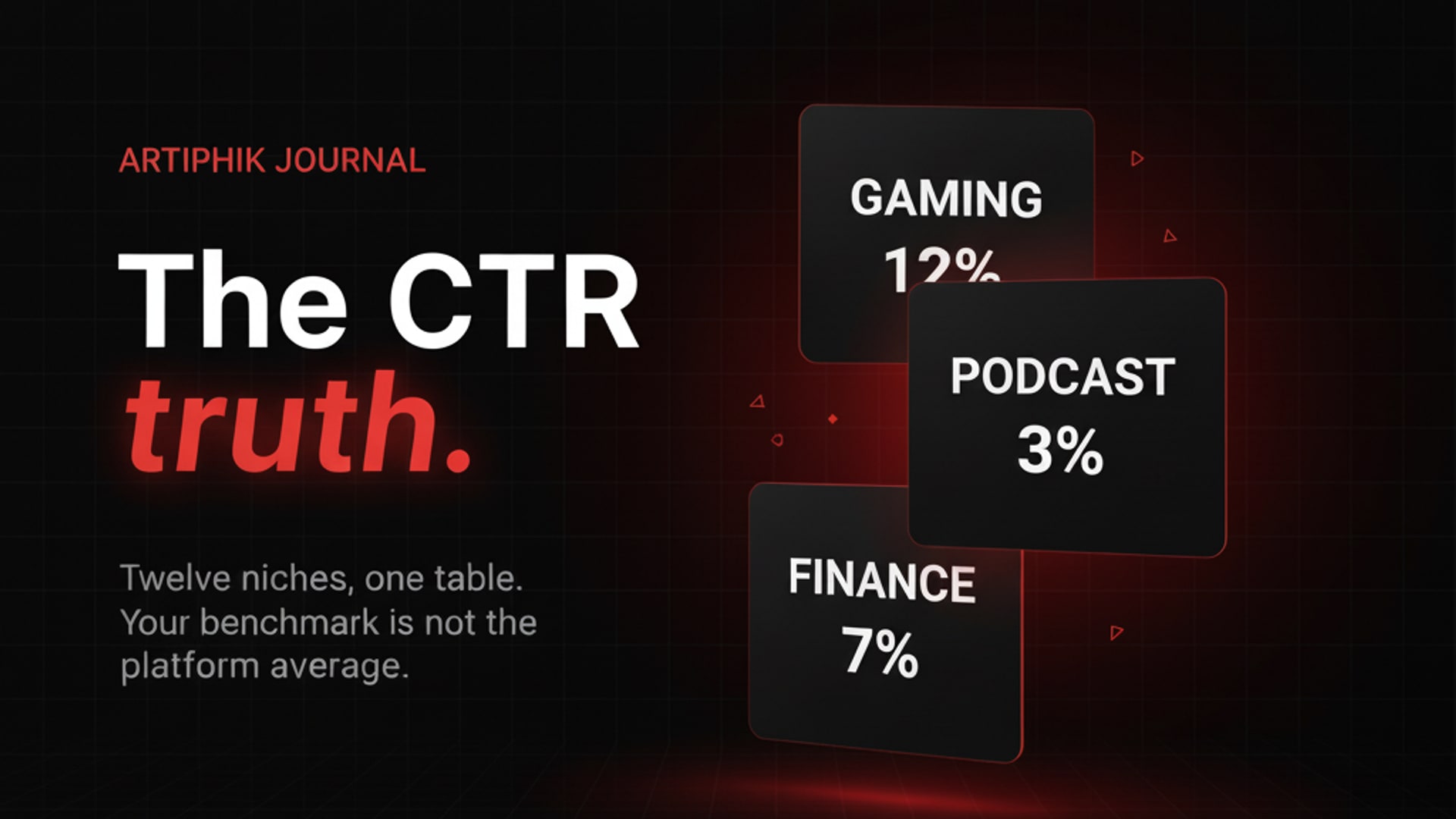
The most common piece of CTR advice on YouTube is also the most useless. "A good CTR is between 4 and 6 percent." It is technically true. It is also unactionable, because it lumps every niche into one average and tells you nothing about whether your specific channel is winning or losing.
Gaming creators routinely hit 8 to 15 percent. Educational creators sit around 4.5 percent. Same platform, very different baselines. Comparing yourself to the platform average is like comparing your marathon time to "the average human walking pace." The number is real. The comparison is meaningless.
This post breaks it down by niche, with the data that exists. Then it explains why the niches differ structurally, what the CTR-retention trap looks like, and what to do if you are below your benchmark.
The headline number, and why you should not use it
Across every niche and content type on YouTube in 2026, the platform-wide average CTR sits between 4 and 5 percent. The "good" range stretches from 4 to 10 percent. Anything above 6 percent is excellent. Anything above 10 percent is exceptional.
That is the published number. Treat it as a sanity check, not a target. The minute you sort by niche, that 4 to 5 percent average splits into two very different worlds.
CTR by niche, the actual table
These ranges come from compiled creator data, agency benchmarks, and YouTube partner case studies through 2026. The bottom of each range is a struggling channel in that niche. The top is a strong channel that has figured out packaging.
| Niche | Typical CTR range | Sweet spot | What good looks like |
|---|---|---|---|
| Gaming | 8 to 15 percent | 10 to 12 percent | Trending game + reaction face + clear stake |
| Entertainment / Comedy | 9 to 14 percent | 10 to 12 percent | Bright color, expressive face, curiosity hook |
| Beauty / Fashion | 6 to 12 percent | 8 to 10 percent | Before / after, close-up face, vibrant tones |
| Lifestyle / Vlogs | 6 to 8 percent | 6 to 7 percent | Personality-led, recognizable creator face |
| Cooking / Food | 5 to 8 percent | 6 to 7 percent | Final dish hero shot, color saturation |
| Tech reviews | 4 to 11 percent | 5 to 7 percent | 4 to 5 percent evergreen, 8 to 10 percent on launch days |
| Fitness | 5 to 9 percent | 6 to 7 percent | Body transformation, before / after split |
| Crypto | 4 to 9 percent | 5 to 7 percent | Price chart in background, ticker overlay, urgency |
| AI / Tech news | 4 to 9 percent | 5 to 7 percent | Vendor logos, model name, news-style framing |
| Personal finance | 3 to 10 percent | 5 to 7 percent | Stack of cash, account screenshot, big number |
| Educational / How-to | 3 to 6 percent | 4 to 5 percent | Result-first thumbnail, no-clutter typography |
| Podcast / long-form | 2 to 5 percent | 3 to 4 percent | Two-shot at mics, guest name, bold one-word hook |
Three things to notice in this table.
First, the range within a niche is wider than the difference between the lowest and highest niche averages. A struggling beauty channel and a strong cooking channel sit at the same CTR. Niche is the floor, packaging is the ceiling.
Second, finance and tech have the widest ranges. That is because both niches contain very different sub-niches, "how to make 10K a month" sits at 7 percent plus, while "tax strategy for self-employed Americans" sits at 3 to 4 percent. Average them together and you get nothing useful.
Third, podcasts sit at the bottom. That is structural, not a packaging failure. Long-form 60-minute interviews are a high-commitment format. The audience self-filters before they click. A 3 percent CTR on a podcast video is healthy. A 3 percent CTR on a gaming video is broken packaging.
Why niches differ, three structural reasons
The niche differences are not random. Three things drive them, and once you see them, the table above stops looking arbitrary.
Audience frequency. A gaming viewer opens YouTube far more often than a personal-finance viewer. More opens means more impressions per upload, more chances to surface, and more compound exposure. The audience also self-trains on thumbnail conventions inside the niche, so click decisions become faster and more predictable. High-frequency niches like gaming, entertainment, and beauty start with a structural CTR advantage.
Visual conventions. Some niches have evolved a tight thumbnail grammar that the audience has been trained to recognize and respond to. Beauty has the before / after split. Gaming has the reaction face plus stake. MrBeast-style entertainment has the focal subject plus single emotion plus number. Niches with strong conventions have higher CTR ceilings because the viewer instantly recognizes the shape and decides on a snap signal. Niches without strong conventions, looking at you, B2B and educational, have lower ceilings because every thumbnail is starting from scratch.
Audience selectivity. Educational, B2B, and how-to viewers click only when the topic matches a specific need. They are not browsing for entertainment. The CTR ceiling is structurally capped because most viewers see the thumbnail, decide it is not what they need right now, and scroll on. That is not a packaging failure. That is the niche.
If you are in a low-CTR niche, the right comparison is other channels in your niche, not the platform average. Beating gaming at gaming's CTR is impossible. Beating educational at educational's CTR is the actual goal.
The CTR-retention trap
Here is the thing that most CTR advice leaves out, and it is the difference between getting recommended and getting buried.
YouTube does not optimize for CTR. It optimizes for session watch-time. CTR is one input. The other is what happens after the click.
A 5 percent CTR with 60 percent average view duration outperforms a 12 percent CTR with 15 percent average view duration almost every time. The 12 percent thumbnail told the algorithm "this video is worth surfacing." Then the 15 percent retention told the algorithm "actually this video is misleading the audience, do not surface it again."
This is why clickbait stops working past a certain channel size. The algorithm starts catching it. It does not stop you from getting clicks. It stops you from getting the next impression.
The version of "good CTR" that matters is, your CTR minus your retention gap. If your CTR is 8 percent and your retention is 25 percent, you have a high CTR and a broken video. If your CTR is 4 percent and your retention is 65 percent, you have a healthy video that needs better packaging.
Most growth-plateaued channels are the first kind, not the second.
CTR by channel size, what changes as you grow
CTR is not a fixed property of your channel. It moves as your subscriber base grows, and the dynamics change at three rough thresholds.
Under 1,000 subscribers. Your CTR is almost entirely cold-traffic CTR, viewers who do not know you, deciding from the thumbnail and title alone. A 3 percent CTR is acceptable. A 5 percent CTR is strong. The signal you should track is whether your CTR is trending up across your first 10 uploads. If it is flat or declining, your packaging is the bottleneck. If it is climbing, you are learning.
1,000 to 10,000 subscribers. Subscriber-driven CTR starts compounding. Your existing audience clicks at higher rates than cold traffic, which pulls your average up. A 5 to 7 percent CTR is typical for a healthy channel at this size. If your CTR has not moved up from your cold-traffic baseline, your subscribers are not actually engaged, they subscribed and forgot. That is a different problem than packaging.
10,000 plus. CTR splits into two segments, your subscribers, who click at 10 to 20 percent or higher, and impressions from browse and search, where you compete on packaging alone. The blended number you see in YouTube Studio averages both. If your blended CTR is dropping while your subscriber count is rising, your audience is going cold. If it is holding, your packaging is working at scale.
The mistake is assuming a single CTR target across all three stages. The dynamics are different. The right CTR for a 10K-subscriber channel would be a sign of trouble at 200K.
The first 24 to 48 hours, where CTR matters most
CTR is not a long-term ranking factor. It is a gate, and the gate slams shut early.
When you upload, YouTube shows your video to a small initial test pool, mostly your subscribers and a few cold viewers. CTR and early retention together decide whether YouTube expands to a wider impression pool. A weak CTR in the first 48 hours is much harder to recover from than weak retention, because the algorithm simply stops surfacing the video. There is no second chance impression at scale.
The two signals that matter in the first 48 hours, in order:
- CTR above your channel's recent average. Even by 0.5 percent.
- Average view duration above your channel's recent average. Even by 5 percent.
If both are up, the impression pool expands. If CTR is up but retention is flat, the pool expands more cautiously. If CTR is down, the video usually never recovers, no matter how good the retention is on the small pool that did click.
This is why pros swap thumbnails within 2 to 6 hours of upload if CTR is weak. They are not panicking. They are trying to clear the gate before it closes.
What to do if your CTR is below your niche benchmark
Three things, in this order. The order matters more than the specifics.
One. Fix the focal point. Pull up your last 5 thumbnails on your phone, in the YouTube app, on the home feed. If you cannot tell what each video is about in half a second, the focal point is broken. Most CTR gains come from removing things from the thumbnail, not adding them. One subject. One emotion. One number or stake. Everything else is noise. The thumbnail design framework covers this in detail.
Two. Fix the text. Two to four words, maximum. Readable at 200 pixels wide on a dimmed phone screen. Bold sans-serif, heavy weight, with stroke or shadow against any background. The trap is using the text to explain the video. The text is a hook, not a caption. Pick the shortest version that still carries the curiosity gap. The title formulas post has the seven hook patterns that work in 2026.
Three. A/B test, but only against your current best. Most creators run two designs against each other, neither of which is their existing thumbnail. That is a waste. Test new designs against the version that is already running, with at least 1,000 impressions of data per variant before you call a winner. Anything less is noise. Tools like TubeBuddy, VidIQ, and YouTube's native experiments handle the impression split automatically.
What does not work, generally, is iterating on color, font, or filter. Those are the visible part of a thumbnail and the smallest CTR lever. Focal point, expression, and text wording move the number. Color and font polish it.
If you have run all three and your CTR is still below your niche benchmark, the bottleneck is probably topic selection, not packaging. That is a different problem and harder to solve, but it is not a thumbnail problem.
How Artiphik handles this
The reason most thumbnails miss the niche benchmark is not the design tools. It is that the design conventions inside each niche are invisible to most creators. A finance creator who has only ever made finance thumbnails has never absorbed what makes a beauty thumbnail or a gaming thumbnail click. They optimize inside their niche's existing patterns, never crossing them.
That is the gap the Artiphik agent is built around. It respects your niche's grammar by default, so a finance brief generates thumbnails that match how strong finance creators package, not generic AI-stock compositions. Same for gaming, beauty, tech, podcast, and the rest of the niches on the table above.
Start free with our YouTube thumbnail tester: drop in the thumbnail from your most recent upload and see how it reads at feed size against the benchmark above. Then try the agent's free tier. Two thumbnails on the free plan, no card. If your current CTR is below your niche benchmark, run a brief and compare what comes out against the thumbnail on your most recent upload. The gap, if there is one, is the packaging delta you are leaving on the table.
CTR is a number. Your niche benchmark is the only number that matters when you read it.
Related: why your thumbnail matters more than your title, the 5 patterns in every viral MrBeast thumbnail, and the 7 YouTube title formulas that actually work in 2026.