
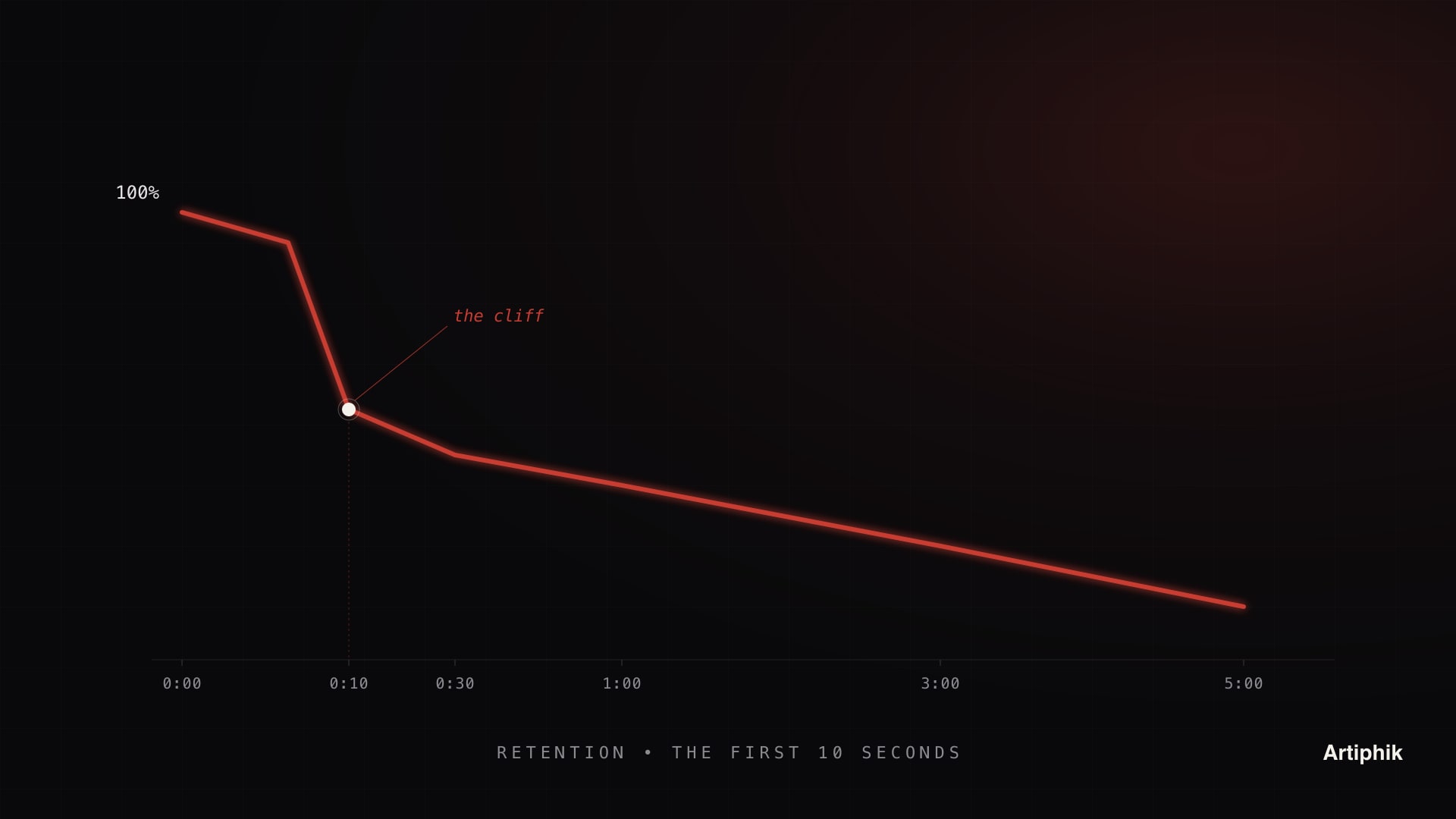
The first 10 seconds of your video decide whether the next 10 minutes get watched at all.
That is not creator-economy hype. It is what the YouTube algorithm watches for. The system is looking at one signal more than any other in the first half-minute, retention rate. If too many viewers click off before 0:30, the video stops getting pushed into Suggested and Browse. If retention holds, the algorithm keeps spending impressions on it. Everything you do upstream, the thumbnail, the title, the niche fit, ends at the play button. After that, the video has to earn the next click on its own.
Most creators know this. Most creators still ship videos that bury the hook 30 seconds in. This post is a playbook to fix that.
30-second retention benchmarks by niche
These ranges come from compiled creator data and analytics tooling reports through 2026. The bottom of each range is a struggling channel. The top is a channel that has figured out openings.
| Niche | Typical 30s retention | Sweet spot | Common failure mode |
|---|---|---|---|
| Long-form podcast | 75 to 90 percent | 85 percent plus | Slow guest intro before any tease |
| Gaming | 70 to 85 percent | 80 percent plus | Logo card and "what is up guys" filler |
| Reaction / commentary | 65 to 80 percent | 75 percent plus | Reading the original tweet word-for-word |
| Personal finance | 65 to 80 percent | 75 percent plus | Defining terms instead of stating the stake |
| Education / tutorial | 60 to 75 percent | 72 percent plus | "In this video we will cover..." preamble |
| AI / tech news | 60 to 75 percent | 70 percent plus | Recapping yesterday's news before today's |
| Cooking | 60 to 75 percent | 70 percent plus | Equipment shots before the dish reveal |
| Vlog / lifestyle | 55 to 70 percent | 65 percent plus | Long b-roll montage before any scene |
| Fitness | 55 to 70 percent | 65 percent plus | Warmup explainer before the actual workout |
| News / commentary | 50 to 70 percent | 65 percent plus | Headline read before the angle |
If you are below the bottom of your range, the first 10 seconds is the most leveraged thing you can fix. Editing the opening of an existing video can lift retention more than re-recording the entire piece.
Why 10 seconds is the right window to obsess over
YouTube does not publish exact numbers. The pattern that holds across thousands of channels is that the steepest single drop-off in any video happens between 0:00 and 0:15. The viewer is making a decision in those seconds, did the video deliver on what they thought they were clicking on, or did it not.
If the answer is yes, retention flattens out and stays high until natural drop-off points later in the video. If the answer is no, the viewer leaves and takes a chunk of your watch time with them. A video that loses 35 percent of viewers in the first 10 seconds will almost never recover that audience by 5:00. They are gone.
That is why 10 seconds is the window worth obsessing over. It is short enough to engineer line by line. It is long enough to actually deliver a hook. And it is the single segment of the video that has the largest impact on every other metric the algorithm scores.
The 5-part structure that holds attention
Look at any video that maintains 80 percent plus retention through the first 30 seconds and you will see a version of this structure. It is not formulaic in a bad way. It is the rhythm that matches how a viewer's attention actually works.
Stake (0:00 to 0:02). What is at risk, what is being promised, what is the payoff. State it plainly. Not "today we are going to be talking about" but "I lost 40 thousand dollars in three days and I figured out exactly what went wrong." The stake earns the next 8 seconds.
Visual lock (0:02 to 0:04). A specific, concrete image that proves the stake is real. The before photo. The bank account screenshot. The reaction face. The graphic of the result. Nothing the viewer has seen in the thumbnail. Something that reinforces what you just said.
Curiosity gap (0:04 to 0:07). Tease the answer without giving it. "And the reason it happened was not what you would think." Or, "the fix took me one week and it works for any creator." This is what pulls the viewer past the part where they would otherwise tab away.
Credibility marker (0:07 to 0:09). A number, a date, a result, anything that signals you actually know. "I have run this on 14 videos now." "I have been editing for nine years." "This is the third time it has happened to me." One sentence is enough. Skip if the niche does not call for it.
Transition into the body (0:09 to 0:12). Break the fourth wall with intent. "Here is exactly what I changed." Or, "let me show you the three rules." The viewer should feel like the video is starting now, even though they have already been watching for 10 seconds. That is the sign you did this right.
The mistake creators make is using all 10 seconds for the stake and skipping the visual lock and the curiosity gap. The stake alone does not hold attention. The structure does.
Mistakes that kill the first 10 seconds
The pattern is consistent across niches.
- Animated intro before the hook. A 3-second logo animation costs 8 to 15 percent of your audience. They never come back.
- "What is up guys, welcome back to the channel." Says nothing. Gives the viewer no reason to stay. If you must greet, do it after the hook lands.
- Defining the topic before stating the stake. "Today we are going to be talking about retention." The viewer already knows the topic, that is why they clicked. Skip the framing and start with the answer.
- Slow b-roll montage with no voiceover. B-roll without payoff is filler. Use b-roll to support a stake, not to pad the opening.
- Reading the title back to the viewer. They already read it. Tell them something the title did not.
- Burying the hook 25 seconds in. Most rough cuts have the actual hook somewhere in the first 60 seconds. Find it. Move it to 0:00. Cut everything before it.
Most retention problems are not script problems. They are edit problems. The hook is usually already in the footage. It is just in the wrong place.
A 3-step playbook to engineer your own first 10 seconds
You do not need to redesign your whole content style. You need a repeatable pre-flight check before any video ships.
Step 1: Find the strongest claim or moment in the entire script. Read the full draft. Mark the line that would make a stranger stop scrolling. That is your stake. It almost certainly is not in the first 10 seconds yet.
Step 2: Rewrite the opening 12 seconds around that stake. Stake first. Visual lock second. Curiosity gap third. Credibility (if relevant) fourth. Transition fifth. The order matters. If you put the credibility before the stake the viewer leaves before the stake lands.
Step 3: Watch the cut on mute. Then watch it without picture. Both have to work. If the visual track alone does not communicate something specific in the first 5 seconds, the visual lock is too generic. If the audio alone does not give the stake in the first 4 seconds, the script is buried.
Do this on every video for one month. The retention number will move. It will not move in week one because you are still learning the structure. It will start moving in week three when the rewrites become muscle memory.
What to do next
If you are scripting for retention, get the opening on paper before you film. The hook structure above is faster to write than to improvise. Drafting it in advance also lets you test variants. Three different stakes for the same video. Pick the strongest one before you commit to a take.
Artiphik's script tool generates retention-aware scripts in your voice, with retention markers built into the structure. Two-column format, camera cues, b-roll suggestions tied to the stake. Free to start, two scripts to try, no card required.
If you are still working on the click that brings viewers to the player in the first place, start with the upstream side. Better packaging gets you more clicks. Better retention keeps them.
Related reads:
- Write the promise first with our free title generator, because the opening 10 seconds can only pay off a promise that was worth making
- Why thumbnails matter more than titles
- YouTube CTR benchmarks by niche
- YouTube title formulas that actually work