
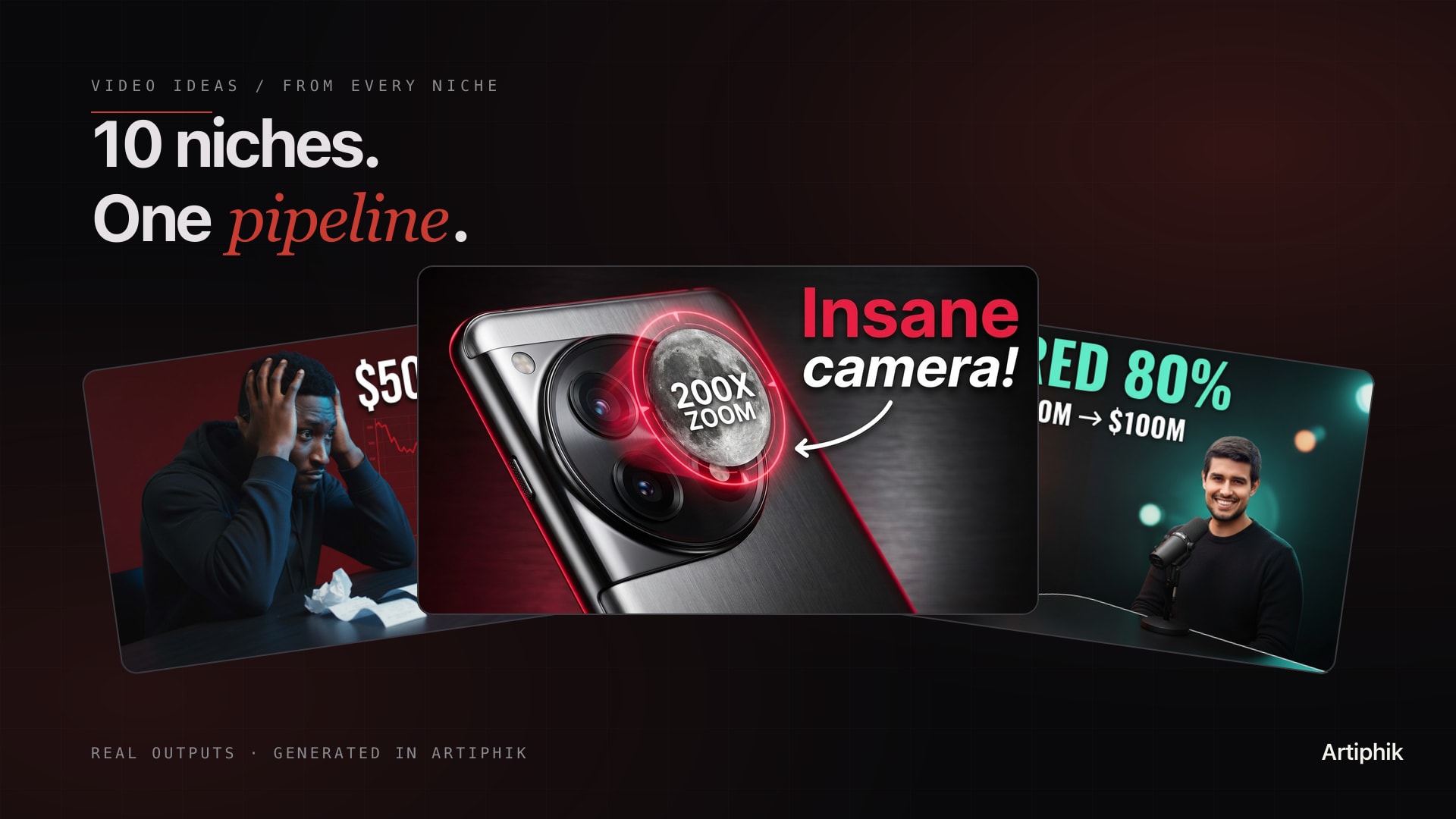
Ideas are not rare. Bad ideas are everywhere. Good ideas, the kind that hold attention for 8 minutes and get clicked at 8 percent CTR, are what is rare.
The creators who never seem to run out of ideas are not more creative than you. They have a better intake pipeline. They have decided where ideas come from and built a habit of harvesting from those sources weekly. The output looks like inspiration. It is actually infrastructure.
This post is a framework for where ideas actually come from, what kills them on the way to filming, and a 30-minute sprint for finding 10 in a row when the well feels dry.
Where good ideas actually come from (by niche)
Most creators think ideas come from sitting alone with a notebook. They almost never do. Across surveys of channels that publish weekly without burning out, the same five sources show up over and over. The mix shifts by niche.
| Niche | Top idea source | Second source | Common failure |
|---|---|---|---|
| Finance / personal finance | Audience questions (search, DMs) | Competitor pattern-matching | Recycling generic "5 tips" lists |
| Education / tutorial | Comment requests | Sequels to own hits | Ignoring what people already asked for |
| Tech reviews | New product launches | Comparison requests | Reviewing only what brands send |
| AI / news | Trending topics (daily) | Reaction to other creators | Recapping yesterday instead of leading |
| Fitness | Audience progress questions | Own past challenges | Generic "10-minute workout" videos |
| Gaming | New release windows | Meta shifts | Same game, no novel angle |
| Vlog / lifestyle | Personal life events | Own past viral moments | Pretending life is more interesting than it is |
| Cooking | Seasonal ingredients | Audience cravings (comments) | Following only Pinterest trends |
| Long-form podcast | Guest network | Listener questions | No prep, hoping for magic |
| Reaction / commentary | Viral content | Industry drama | Reacting to anything for the click |
The pattern is consistent. The best idea sources are not invented. They are observed. Your audience and your niche are already telling you what they want to watch. The job is to listen, not to brainstorm in a vacuum.
The 5 sources every weekly creator harvests from
Pick a recurring slot, 30 minutes once or twice a week, and run the same intake every time.
Source 1: Your comments and DMs. Your audience tells you what they want next, in plain English, every single video. The top three questions on your last five videos are your next three videos. If you have 200 comments and you cannot find three questions, you are reading them wrong. Look for "but what about" and "could you do" and "I tried this and it did not work."
Source 2: Your search data. YouTube Studio shows what people typed to find your videos. Anything that brought traffic but does not match an existing video on your channel is a free idea. The viewer told the algorithm what they wanted. The algorithm sent them to you. They settled. Make the video they actually wanted.
Source 3: Your competitors' breakouts. Once a week, scan the top-performing videos of three to five channels in your niche. Not their average uploads, the ones that are 5x their normal view count. Those are signals. Same topic? Already taken. Same format with your own angle? Worth taking.
Source 4: Your own past hits. Every video that performed above your channel average is a parent. It has children. Sequels ("six months later"), updates ("what I learned since"), opposites ("why I was wrong"), deep dives ("part 2 on the one section everyone asked about"). A single hit can produce four to five follow-ups.
Source 5: Trending in your specific niche. Not what is trending on the YouTube homepage. What is rising in the last 7 to 30 days in your category. Google Trends for "rising" queries. YouTube search sorted by date. The new things people are asking about, before everyone has covered them.
The creators who post weekly without burnout do not invent. They harvest.
What separates a good idea from a bad one
The test is simple. You can run it in five minutes before you write a single line of script.
Can you write the thumbnail before you film? If you cannot picture a single frame that captures the idea, with one focal subject and a two-to-four-word text overlay, the idea is too abstract. "Tips on saving money" fails. "I cut my rent in half doing this" passes.
Can you write the title in 60 characters? If the title needs more than 60 characters to make sense, the idea is doing too much. Cut scope until one sentence handles it.
Does it pass the "what was the answer" test? If you say the title out loud to a friend and they do not immediately ask what the answer is, there is no hook. They have to want the payoff. "How I edit videos" fails. "The 3 edits that doubled my retention" passes.
Does it map to a stake? What is at risk for the viewer if they do not watch? Wasted time, wasted money, missed opportunity, FOMO. If you cannot name the stake, the algorithm will not push the video.
If an idea fails any of those four, it is not a bad idea. It is an unfinished idea. Refine it or shelve it.
Mistakes that kill good ideas before they become videos
The same patterns kill ideas in every niche.
- Letting the idea grow. A good idea is one stake, one promise, one payoff. The moment you say "and we should also cover" the scope inflates and the hook dilutes. Every "and" in your outline is a future drop-off point.
- Filming before packaging. If the thumbnail and title come last, you are scripting blind. Make the thumbnail first. The whole video should serve the click promise, not the other way around.
- Originality for its own sake. "Nobody has done this" usually means "no audience has searched for this." Original ideas with no demand are hobby projects, not channel growth.
- Researching forever. A weekly creator does not get to spend three days researching. The 30-minute sprint below is enough. If an idea cannot survive 30 minutes of pressure, it cannot survive 8 minutes of viewer attention.
- Saving the best for "when I am ready." The best idea in your notes app is the one you should film this week. Future-you is not better at executing it. Future-you has a better current idea.
The 30-minute idea sprint
When you are stuck, run this. It works because it removes the part where you stare at a blank document.
Minutes 0 to 5: Pull from comments. Open your last 5 videos. Write down every comment that has a "?" in it. Group similar questions. The question with the most variants is your next video.
Minutes 5 to 15: Pull from competitors. Open three competitor channels. Sort by "Most popular." Write down their top 3 videos each. You now have 9 candidates. Pick the format you like and adapt the topic to your angle.
Minutes 15 to 25: Pull from your own hits. Open your YouTube Studio. Sort by views. For the top 3 videos, write a sequel idea, an update idea, and a deeper-dive idea. That is 9 more candidates.
Minutes 25 to 30: Filter. You now have 18 to 25 candidates. Run the four-question test on each. Keep the ones that pass all four. Most weeks you will land 6 to 10 keepers in 30 minutes.
That is your idea bank for the next month. The job is not to find one idea. It is to build a queue you can pull from on Monday morning.
What to do next
If the bottleneck is not the idea but the packaging, the thumbnail and the title are the two surfaces every idea has to survive. The structure of a good thumbnail is in how to design YouTube thumbnails that get clicks. The structure of a title that earns the click is in YouTube title formulas that actually work.
If the bottleneck is keeping the audience once they click, the first 10 seconds is where most channels lose them, the retention playbook is here.
Artiphik's idea engine pulls from your channel data, your niche's top performers, and trending searches to surface ideas that pass the four-question test before you ever start scripting. Free tier, no card required.
Ideas are not rare. Filtered, packaged, ready-to-film ideas are. Build the pipeline once. Pull from it every week.
Want the shortcut? The free YouTube video ideas generator takes your niche and returns 10 scored ideas with hooks, modeled on the outliers and trends in your niche. No signup needed for the first run.