
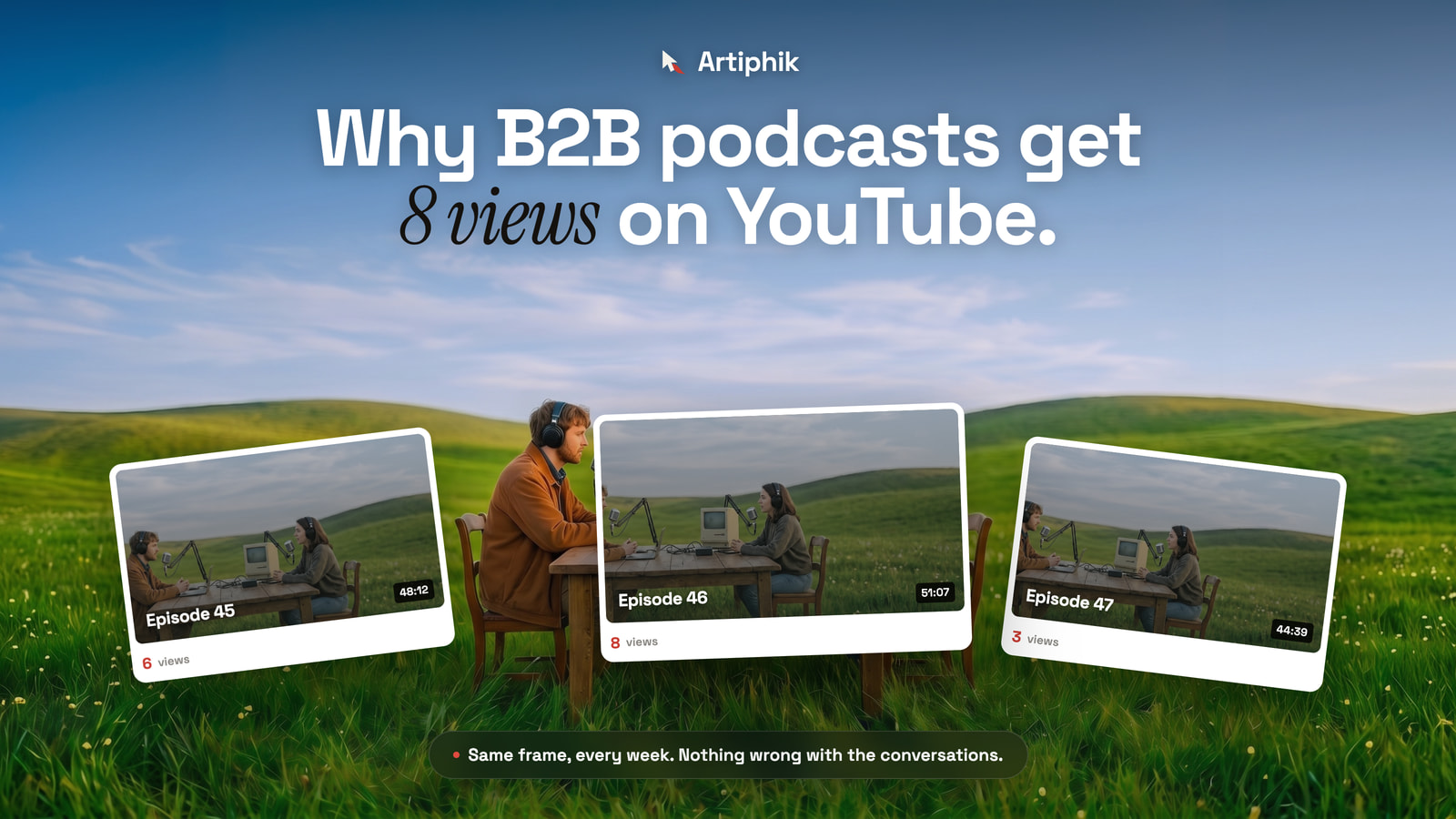
We pulled up a hundred company podcasts on YouTube. Real businesses, real budgets, real shows, published week after week.
One of them, a company selling software to car dealerships, has published 387 videos. Their most recent upload had one view.
Another is publicly traded. 144 videos. Four views on the latest.
A third has 278 videos and 17 subscribers. They upload something almost every day.
None of these are bad companies. None of them are lazy. Every one of them is doing the hard part, which is showing up and recording, and getting almost nothing back for it.
Here is what is actually going wrong.
The number that tells you everything
Forget views for a second and look at one ratio: videos published against subscribers earned.
A healthy channel earns many subscribers per video published. Every upload brings people who stay, so the audience compounds and each new episode starts from a higher floor.
Across the company podcasts we looked at, the ratio was frequently worse than one to one. More videos than subscribers. Sometimes a lot more.
That ratio is not a content problem. Publishing 278 videos means you can hold a conversation and hit a deadline. If none of them earn a subscriber, the videos are not failing after people watch. They are failing before anyone watches.
YouTube never gave you a chance to be good
Here is the part most companies get wrong about how YouTube works.
Your episode is not competing on quality. It is competing for a click, against about twenty other rectangles on a screen, most of which are made by people who do this professionally.
YouTube shows your video to a small number of people first. If enough of them click, it shows it to more. If they do not, it stops. That decision gets made in under a second, based on a thumbnail about the size of a postage stamp and a line of text.
Nobody in that first test group has heard your conversation. They are judging a picture and a title.
So when a company podcast gets eight views, the eight is not a verdict on the episode. It is a verdict on the packaging. The conversation was never auditioned.
What the bad ones have in common
The failing channels we looked at were remarkably consistent. Five things, over and over.
The thumbnail is a screenshot. Two people wearing headphones, sitting at a desk, mid-sentence, in a frame that looks identical to the last forty episodes. At the size a thumbnail actually displays on a phone, you cannot tell one from another. There is no reason to pick this one.
The title is an internal label. "Episode 47 with Dave Richardson." That is a filing system, not a promise. It tells a stranger nothing about why they should spend forty minutes with you. Nobody outside the company knows who Dave is.
Every upload looks the same. Same frame, same layout, same crop. The channel becomes wallpaper. Even someone who liked a previous episode scrolls past because their eye has learned there is nothing new here.
The clips are cut by a machine. Sixteen shorts a week, each one starting mid-thought and ending before the point lands. They get four views and quietly teach the algorithm that this channel produces things people do not finish.
Nobody at the company shares it. The brand account posts. Nobody else does. The guest, who has an audience of their own and every reason to be flattered, gets a link three weeks late and never posts it at all.
The most expensive version of this
One company we looked at sells a tool that tests whether video messaging works. Their own channel has 262 videos and 100 subscribers. The most recent has one view.
Another sells investor visibility, which means their whole product is helping companies get seen. 375 videos, 99 subscribers.
Neither is incompetent. Both are proof of how invisible this problem is from the inside. When you are close to the work, the episode feels finished the moment the export completes. The thing that decides whether anyone sees it feels like an afterthought, so it gets made in four minutes at the end of the day.
The inverse problem, which is good news
One channel in our set had 77 subscribers and was getting 258 views per episode.
That is backwards from everyone else, and it is the most encouraging thing we found. People were finding those episodes and watching them. They were simply never asked to come back, and nothing on the page pointed at another episode.
That is a fixable problem measured in hours. It also tells you the content was fine all along.
What to do about it
In order of what pays out fastest.
Repackage your five best episodes. Not the five most recent, the five best conversations. New thumbnail, new title, for each. Old episodes keep getting recommended for years, so a better thumbnail on a good episode compounds quietly for a very long time. This is the highest-return afternoon available to you.
Write titles for a stranger. Not "Episode 47 with Dave Richardson." What did Dave actually say that someone who has never heard of him would want to know? If the best line in the episode is that he thinks most of his industry is measuring the wrong thing, the title is about that. The guest's name goes at the end, if at all.
Make thumbnails readable at postage-stamp size. One face, one clear expression, three or four words maximum, hard contrast. Open your own channel on a phone and look at your last ten episodes. If you cannot tell them apart at a glance, neither can anyone else.
Cut fewer clips, by hand. Four clips that contain a whole idea beat sixteen that stop halfway. Independent testing of the major AI clipping tools in 2026 put the discard rate at roughly 40 percent, and multi-speaker interviews are the worst case for them, which is exactly what a podcast is.
Send the guest something they will actually post. Their clips, cut for their feed, ready to go, within a couple of days while the conversation is still fresh. Guests almost never share episodes, and it is nearly always because sharing was made into work.
What good looks like
We took one B2B company channel from under 1,000 subscribers to more than 180,000.
The conversations did not get better. The company did not get more interesting. What changed was that every episode got a title written for someone who had never heard of us, a thumbnail built to be read on a phone, and clips chosen by a person who had watched the whole thing.
That is the entire difference between 8 views and a channel that compounds.
The honest summary
If your company podcast gets eight views, you are probably not bad at podcasting.
You are invisible, which is a completely different problem with a completely different fix. The conversation is the hard part and you are already doing it. The part that decides whether anyone hears it takes a fraction of the effort and is being treated as an afterthought.
Start with five thumbnails. See what moves.
We produce and grow B2B podcasts. If your show has more episodes than subscribers, that is the problem we work on.