
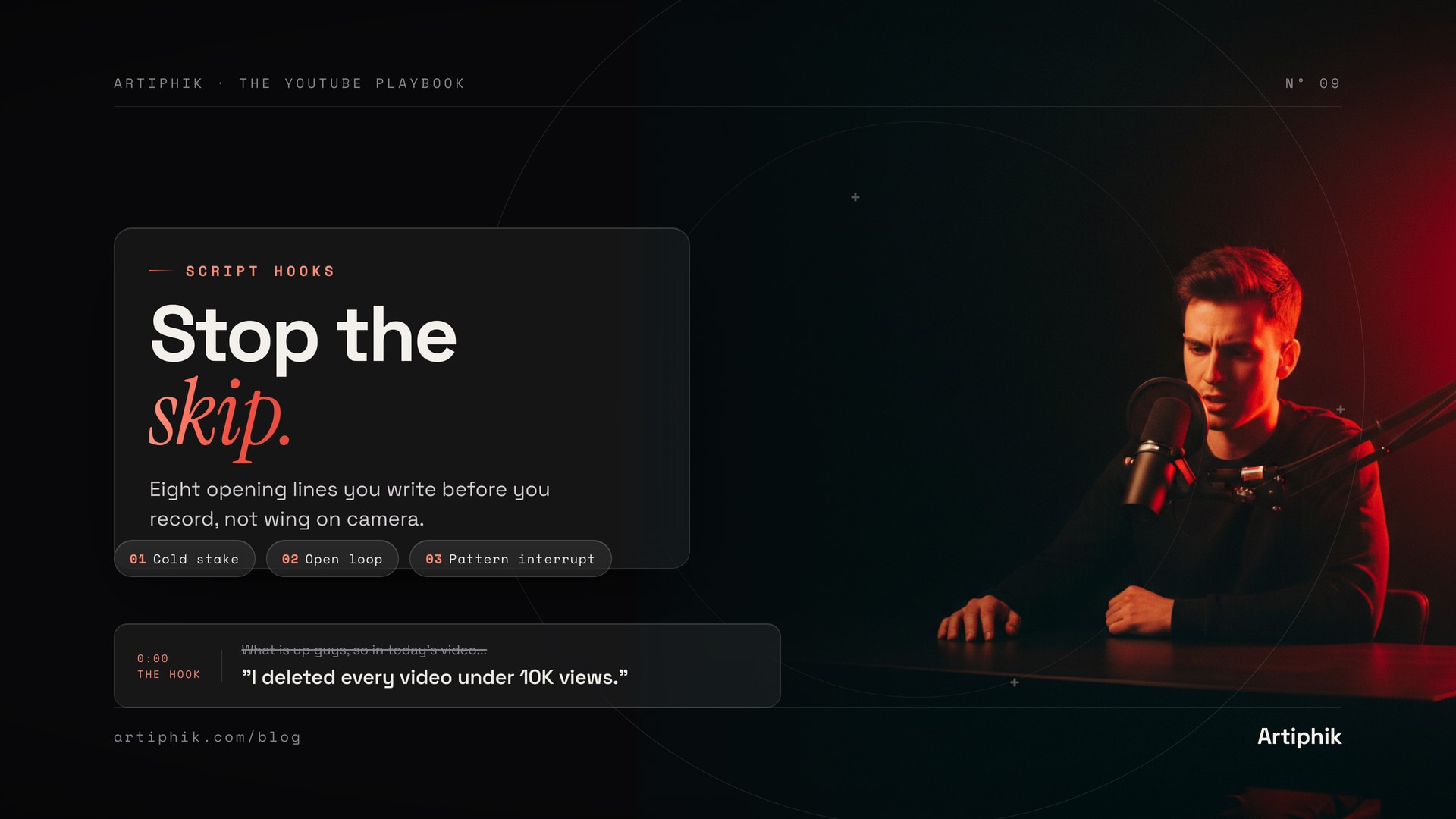
The first frame decides whether someone clicks into your video. The first sentence decides whether they stay.
Those are two different jobs, and most creators only plan the first one. They obsess over the thumbnail and the title, then open the actual video with "what is up guys, so in today's video." The packaging earns the click. The opening line throws it away.
This is a companion to the first 10 seconds retention playbook. That post breaks down the retention curve and the timing structure of a strong opening. This one is about the words themselves, the literal hook line you write into the script before you ever hit record. Eight templates, real examples by niche, the openers that quietly bleed your audience, and a drill to test any hook in under a minute.
The hook is a line you write, not a moment you wing
Here is the shift that changes everything. A hook is copy. It is a sentence you can draft, rewrite, and A/B in your head before filming, the same way you would a title.
When creators improvise the opening on camera, they default to filler, because filler is what comes out of your mouth when you have not decided what to say. The greeting, the channel plug, the slow ramp into the topic. None of it is a choice. It is the absence of a choice.
Writing the hook in advance forces the choice. It also lets you test variants. Three different opening stakes for the same video, picked before you commit to a take. That is the entire advantage, and it costs you two minutes of writing.
8 hook templates that hold attention
Each of these is a sentence shape. The structure holds across niches. The content inside it comes from your video.
1. The cold stake. Open with what is on the line, stated flat, no setup. Template: "I [did the risky thing] and [the consequence], and here is exactly what happened." Example: "I deleted every video on my channel with under 10 thousand views, and my watch time went up the next week." Use when your video has a real result, loss, or transformation. The strongest opener when you have one.
2. The open loop. Pose a question or tension you do not resolve until later. Template: "There is one [thing] that [surprising outcome], and almost nobody is doing it." Example: "There is one setting in your upload flow that is quietly capping your reach, and it is on by default." Use when the payoff needs buildup. The gap keeps them watching for the answer. Pay it off, or it reads as a bait.
3. The pattern interrupt. Say the opposite of what the viewer expects to hear on this topic. Template: "Everyone tells you to [common advice]. That advice is why [bad outcome]." Example: "Everyone tells you to post every day. That advice is why most small channels burn out and quit by month three." Use in saturated niches where the audience has heard the standard take a hundred times.
4. The myth bust. Name a belief the viewer holds, then break it. Template: "You probably think [common belief]. The numbers say something different." Example: "You probably think longer videos always win more watch time. For most channels under 50 thousand subs, the opposite is true." Use for data-driven or educational content. Earns credibility by challenging, not lecturing.
5. The direct callout. Name the exact viewer so they feel seen. Template: "If you have [specific situation], this is the [thing] nobody explained to you." Example: "If you have uploaded 20 videos and you are stuck under 200 subscribers, this is the reason nobody explained to you." Use for top-of-funnel content aimed at a clear audience segment. Cuts through because it feels personal.
6. The number promise. Front-load a specific, countable payoff. Template: "Here are [number] [things] that [outcome], and number [X] is the one that actually moved the needle." Example: "Here are 5 thumbnail changes that doubled my click rate, and number 4 is the one that actually moved the needle." Use for listicles and tactical content. The "number X is the one" tease pulls viewers deep into the video.
7. The stakes escalation. Start small, then raise what is at risk in the same breath. Template: "This started as [small thing]. It turned into [much bigger thing]." Example: "This started as a test on one video. It turned into the framework I now use on every upload." Use for story-driven or case-study videos where the scope grows.
8. The contradiction hook. State two things that should not both be true. Template: "I [did less of X], and [counterintuitive better result]." Example: "I cut my editing time in half, and my retention went up. Here is what I stopped doing." Use when your result defies the obvious assumption. The tension is the hook.
Which hook fits your niche
No template is universal. The right shape depends on what your audience already expects when the video starts.
| Niche | Hooks that land | Why |
|---|---|---|
| Personal finance | Cold stake, myth bust | Audience wants stakes and contrarian data, not definitions |
| Education / tutorial | Number promise, direct callout | Viewers came to solve a specific problem, name it fast |
| Gaming | Stakes escalation, contradiction | Story and surprise carry more than claims |
| AI / tech | Myth bust, open loop | Saturated takes, reward a fresh angle |
| Vlog / lifestyle | Stakes escalation, cold stake | Personal narrative needs an early turn |
| Reaction / commentary | Pattern interrupt, contradiction | Audience wants your angle, not a recap |
| Fitness | Direct callout, number promise | Goal-driven viewers respond to specificity |
| Business / creator | Cold stake, contradiction | Results and counterintuition build trust |
If you are unsure, default to the cold stake. It is the hardest to write and the most reliable when you get it right, because a real stake never reads as filler.
4 openers that quietly kill retention
These feel safe. They cost you viewers every single video.
- The greeting. "Hey guys, welcome back to the channel." It says nothing and asks the viewer to wait. Greet after the hook, or not at all.
- The housekeeping. "Before we get into it, smash that subscribe button." You are asking for a favor before you have given anything. Move every ask to the back half.
- The topic restate. "In this video, I am going to talk about hooks." The viewer chose the topic by clicking. Telling them the topic again is a stall, not an opening.
- The slow ramp. "So, a little while ago, I was thinking about..." Backstory before stakes. The story might be great. Lead with its sharpest moment, then fill in the context once they are hooked.
The pattern under all four is the same. Each one delays the payoff and signals that the video will keep delaying it. The viewer leaves on the signal, not the content.
The 30-second hook drill
Run this on any script before you film.
Step 1, find the sharpest line. Read your full script and mark the single sentence that would make a stranger stop scrolling. The biggest number, the boldest claim, the most surprising moment. That is your raw material. It is almost never sitting in your opening yet.
Step 2, wrap it in a template. Pick the hook shape that fits the line and your niche from the eight above. Write the opening as: stake or callout first, gap or promise second. Two sentences, three at most.
Step 3, say it out loud twice. Read your draft hook aloud. Then read one alternate version. The winner is the one that sounds like something you would actually say and makes you want to hear the next sentence. If neither does, your raw material was not sharp enough. Go back to step 1.
Do this on every video for a month. By week three it stops being a drill and becomes how you open by default.
What to do next
The fastest way to get better at hooks is to write them before you film, every time, and to test more than one. A hook on paper can be rewritten in seconds. A hook improvised on camera is locked in the moment you stop recording.
Artiphik's Script Doctor drafts full scripts in your voice, with the hook built into the opening and retention markers through the body. Two-column format, camera cues, b-roll tied to the stakes. Free to start, two scripts to try, no card required.
And if the click that brings viewers to the player still needs work, the hook cannot save a video nobody opens. Fix the packaging first, then keep them with the opening line.
Related reads: